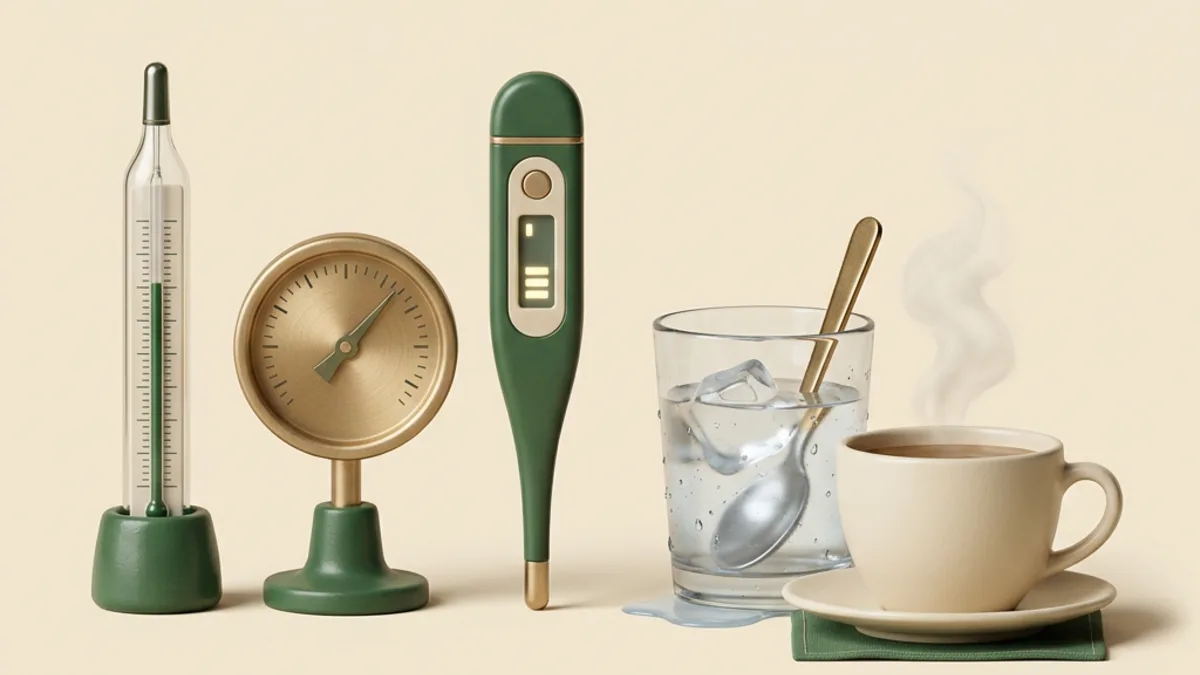
Temperature scales differ in both step size and zero point
Converting a temperature is not always a simple multiplication. Celsius and Fahrenheit use different step sizes and different zero points, so converting a reading needs both a scale factor and an offset. Kelvin uses the same step size as Celsius but starts at absolute zero rather than zero degrees Celsius.
For a Celsius reading, multiply by nine fifths (1.8) and add thirty-two to obtain Fahrenheit. To reverse the conversion, subtract thirty-two first and then divide by 1.8, which is the same as multiplying by five ninths. Changing that order gives a different result. Write the scale beside an input instead of relying on the surrounding conversation to identify it.
Kelvin changes the zero point, not the step size
Add 273.15 to a Celsius reading to obtain kelvin, or subtract 273.15 to convert kelvin to Celsius. Kelvin is written without a degree symbol, as in 273.15 K. A change of one kelvin is the same size as a change of one degree Celsius, even though equal numerical readings represent different temperatures.
To go directly from Fahrenheit to kelvin, NIST gives the formula T = (°F + 459.67) ÷ 1.8. Calculator Simply rejects readings below absolute zero. Negative Celsius or Fahrenheit values are not automatically invalid, since their zero points are above absolute zero. The tool converts standard scale readings; it does not determine whether an instrument is calibrated.
Worked examples from everyday readings
Familiar values are good practice because you can check them against what you already know. A common oven setting, a typical body temperature and the single point where the two main scales agree each show the formula working.
Notice how the oven example lands on an awkward decimal. Recipes that list 350°F next to 180°C have rounded the conversion, which is usually acceptable for cooking but would not be for a laboratory or calibration record.
A temperature difference uses a different rule
A difference between two temperatures is not the same thing as a temperature reading. For a difference expressed in Celsius degrees, multiply by nine fifths to obtain the difference in Fahrenheit degrees without adding thirty-two. The offset cancels when one converted reading is subtracted from another.
The temperature converter expects an actual reading, so do not enter a temperature difference and interpret the result as a difference. Convert both endpoint readings and subtract them, or apply the difference formula separately. This distinction matters when discussing warming, cooling, instrument tolerance or the change between two measurements.
Why quick mental shortcuts drift
A popular shortcut for Fahrenheit to Celsius is to subtract 30 and halve the result. It works tolerably near room temperature because it approximates the 1.8 factor with 2 and the 32 offset with 30, but the error grows as readings move away from that range.
The shortcut is fine for deciding whether to take a jacket. It is not fine for cooking, laboratory work or anything recorded, where the exact formula takes only a moment longer. If the shortcut and the exact answer differ by more than you can tolerate, use the exact one.
Match the precision of the original reading
A conversion can make a rough reading look more precise than it is. A household thermometer that reads to the nearest degree Fahrenheit does not justify two decimal places in Celsius. Round the converted value to a similar level of resolution as the original instrument.
For records, keep the original reading and its scale alongside the converted value. That way anyone checking later can repeat the conversion and see exactly how the rounding was done.
Ratios only make sense on the kelvin scale
Because Celsius and Fahrenheit have arbitrary zero points, saying one reading is “twice as hot” as another has no physical meaning on those scales. Only kelvin, which starts at absolute zero, supports ratios. This is why gas-law and other physics formulas expect temperatures in kelvin.
If a formula multiplies or divides by a temperature, convert to kelvin first. Adding or subtracting temperatures to find a change works on any scale, as long as both readings use the same one.
Common conversion mistakes
The most frequent error is adding 32 before multiplying, which gives (20 + 32) × 1.8 = 93.6 instead of 68. Another is using 273 instead of 273.15 in work that needs full precision, or adding the 32 offset to a temperature difference.
Mixing up which scale a number belongs to is also common in copied data. A value of 30 is a hot day in Celsius and below freezing in Fahrenheit, so the label matters as much as the number.
Use reference points and sensible precision
Check an unfamiliar result against a known reference point, such as water freezing at 0°C (32°F) and boiling at 100°C (212°F) at standard atmospheric pressure. Keep sufficient digits during conversion, then round to a precision appropriate to the source measurement. Extra decimal places do not make an approximate thermometer reading more accurate.
A mathematically correct conversion does not establish a safe food temperature, medical interpretation or industrial operating limit. Use relevant professional guidance for the underlying task, and treat the converter as a transparent way to express the same reading on another standard scale. For other quantities such as length or mass, use the unit converter.